China Best Industrial Air Filter Manufacturers?

Time:2026-10-08 Author:Amelia
0%

China Best Industrial Air Filter Manufacturers? The answer depends on more than factory size or attractive catalog photos. A reliable supplier must show consistent filtration performance, stable materials, and practical manufacturing experience. This matters when filters operate beside CNC machines, coating lines, laboratories, or food-processing equipment.

A capable Industrial Air Filter manufacturer should explain its testing methods clearly. Look for data on efficiency, airflow, pressure drop, dust-holding capacity, and service life. Certifications can support trust, but they should match the intended application. A factory visit may reveal more: pleats formed evenly, galvanized frames sealed tightly, and gaskets fitted without visible gaps. Small details often influence air leakage and maintenance costs.

Experience also appears in the questions a supplier asks. Do they request equipment airflow, particle size, temperature, humidity, and installation dimensions? Do they recommend a suitable filter grade instead of pushing the most expensive option? These signs suggest practical expertise rather than simple sales language. Still, no shortlist is flawless. Testing conditions may differ from real industrial environments, and published figures can hide limitations.

This guide examines leading Chinese manufacturers through product quality, engineering support, customization, production capacity, documentation, and after-sales reliability. It also considers how suppliers respond when a filter fails early or pressure loss rises unexpectedly. The best choice is not always the largest company. It is the manufacturer that provides verifiable evidence, communicates limitations honestly, and delivers stable performance over time.
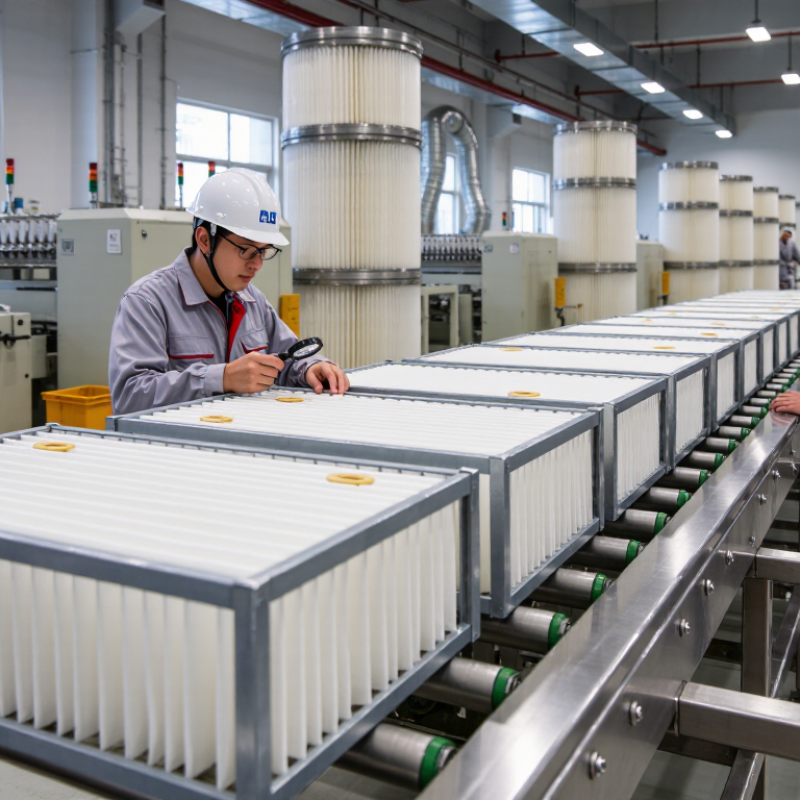
China Best Industrial Air Filter Manufacturers?

What Defines a Leading Industrial Air Filter Manufacturer in China?

A leading industrial air filter manufacturer in China is defined by more than production capacity. It understands where its filters will work: a dusty cement line, a cleanroom, or a food-processing area. Engineers should match media, frame materials, gasket design, and pressure-drop targets to each application. Generic sizing creates expensive problems.

Reliable manufacturers show measurable control on the factory floor. They inspect fiber media, check pleat spacing, and verify sealant curing. Each batch should carry traceable records, including raw-material lots, dimensions, airflow resistance, and test results. Independent testing against recognized methods, such as ISO 16890 or EN 1822, adds confidence when efficiency claims matter. Samples should be tested before a large order, not after installation.

Technical support also separates a capable supplier from a simple exporter. It should explain service intervals, storage conditions, and safe replacement procedures clearly. A useful supplier asks about airflow, temperature, humidity, dust type, and installation space before quoting. Still, no manufacturer is perfect. Media performance may vary between suppliers, and field dust rarely behaves like laboratory dust. Buyers should question unusually low prices, request current reports, and monitor pressure drop after installation. Small omissions can shorten filter life.

Key Types of Industrial Air Filters and Their Applications

China Best Industrial Air Filter Manufacturers?

Industrial air filters protect equipment, workers, and production quality. The right choice depends on particle size, airflow, temperature, and maintenance conditions. In factory inspections, poor filter selection often causes pressure loss before visible dust appears.

Panel filters are common pre-filters for ventilation units and clean production areas. They capture larger dust and protect finer filters downstream. Bag filters provide greater dust-holding capacity in workshops, warehouses, and commercial HVAC systems. Their deep pockets can extend service intervals, but wet dust may reduce performance.

Cartridge filters suit metalworking, woodworking, and powder-processing equipment. Their compact design delivers strong filtration in limited spaces. However, cartridge loading can become uneven when airflow is poorly balanced. Pulse-jet cleaning helps remove accumulated dust, yet compressed air quality and timing require regular checks.

High-efficiency filters are used in pharmaceutical rooms, laboratories, hospitals, and electronics manufacturing. They capture very fine particles, but they should not replace suitable pre-filtration. Otherwise, replacement costs rise quickly. Electrostatic filters can support applications with oily or fine airborne particles, although their performance depends on stable electrical control and proper cleaning.

A reliable manufacturer should provide tested efficiency data, airflow curves, pressure-drop values, and material specifications. Factory trials matter. Actual dust is rarely as simple as a catalog sample. Some selection decisions look correct on paper but fail after humidity, vibration, or irregular maintenance enters the process. Filter dimensions, sealing quality, and delivery consistency also deserve close inspection.

How to Evaluate Chinese Air Filter Manufacturers

How to Evaluate Chinese Air Filter Manufacturers

Choosing a Chinese air filter manufacturer requires more than comparing quotations. The U.S. Environmental Protection Agency reports that indoor pollutant levels can be two to five times higher than outdoor levels. The World Health Organization’s 2021 guidelines recommend annual PM2.5 exposure below 5 μg/m³. These figures make filtration performance and testing evidence essential.

Check whether the factory follows ISO 16890 for general ventilation filters or EN 1822 for high-efficiency filters. Request complete test reports, not only certificates. Review initial pressure drop, airflow, efficiency, leakage results, and test conditions. A reliable supplier should explain its media source, adhesive process, frame materials, and batch traceability. Visit the production line when possible. Look for clean assembly areas, calibrated instruments, and retained samples. A polished showroom proves little. No scorecard is perfect.

Tips: Compare equivalent specifications. Ask for samples from three production batches. Test them independently before approval. Confirm packaging strength, storage limits, lead times, and replacement procedures. Calculate total operating cost, because a cheaper filter may create higher fan energy use. According to the U.S. Department of Energy, fan power rises as system resistance increases. My own caution is simple: factory claims can sound precise, yet test conditions may not match your building. Require written assumptions, field validation, and a clear remedy for failed results.

Manufacturing Standards, Quality Control, and Certifications

Choosing among China’s best industrial air filter manufacturers requires more than comparing price, capacity, or catalog photographs. Manufacturing standards reveal process discipline. ISO 9001 supports documented quality systems, while ISO 14001 and ISO 45001 address environmental and workplace controls. These certificates matter only when audits, corrective actions, and production records remain current.

Test the filter, not just the factory promise. ISO 16890 evaluates general ventilation filters by particulate efficiency, while EN 1822 applies to high-efficiency and HEPA filters. ASHRAE Standard 52.2 measures particle removal efficiency and pressure drop under controlled conditions. Ask for independent reports from an ISO/IEC 17025-accredited laboratory. Each report should identify airflow, test dust, efficiency, pressure drop, and sample number. Small details matter.

The U.S. Environmental Protection Agency reports that indoor pollutant concentrations are often two to five times higher than outdoor levels, and sometimes far higher. That makes leakage control and stable performance commercially important, not cosmetic. Review gasket compression, frame tolerances, media batch records, and final inspection photos. Lot traceability should connect raw material certificates to shipped cartons. It sounds basic.

It is often missing.

A factory audit should include calibration logs, rejected-product records, and witness testing. One successful sample does not prove consistent production. I would also question unusually low pressure-drop claims; efficiency, service life, and energy use must be considered together. No certification replaces site-specific validation.

China Best Industrial Air Filter Manufacturers? - Manufacturing Standards, Quality Control, and Certifications

Evaluation Dimension Relevant Requirement or Standard Typical Industrial Application Evidence to Request from a Manufacturer
Quality management system ISO 9001:2015-based quality management system Controlled design, purchasing, production, inspection, and corrective actions Valid certificate, certification scope, issuing body, and audit validity
Environmental management ISO 14001:2015, where applicable Management of energy use, waste, emissions, and production-related environmental impacts Certificate, site scope, environmental objectives, and compliance records
Occupational health and safety ISO 45001:2018, where applicable Risk control for handling fibers, adhesives, machinery, and testing equipment Valid certificate and documented workplace safety procedures
Particulate performance classification ISO 16890 for general ventilation air filters; results reported as ePM1, ePM2.5, ePM10, or coarse HVAC systems, commercial buildings, factories, and pre-filtration stages Laboratory test report showing efficiency, pressure drop, conditioning method, and filter dimensions
HEPA and ULPA classification EN 1822 or ISO 29463 for EPA, HEPA, and ULPA filters Cleanrooms, pharmaceutical production, laboratories, hospitals, and critical process areas Individual filter scan-test report, efficiency class, MPPS result, and pressure-drop data
North American efficiency rating ANSI/ASHRAE Standard 52.2, including MERV reporting Air-handling units and filtration systems designed for North American specifications Accredited test report stating MERV rating, particle-size efficiency, and resistance
Initial pressure drop Measured at a specified airflow and tested according to the applicable product standard Energy-sensitive HVAC and industrial ventilation systems Pressure-drop curve, test airflow, face velocity, filter size, and measurement uncertainty
Airflow and dimensional consistency Drawings and tolerances controlled through documented production inspection Panel, pocket, cartridge, pleated, and high-temperature filter assemblies Approved drawings, dimensional inspection records, airflow test data, and batch traceability
Filter media inspection Incoming-material verification for media, wire, frames, gaskets, sealants, and adhesives All industrial filter types, especially high-efficiency and chemical-resistant products Material certificates, supplier batch records, fiber or media specifications, and inspection plans
Structural integrity Frame strength, pleat stability, separator or spacer security, and gasket integrity verified against the intended service conditions Vibration-prone equipment, high-airflow systems, and demanding industrial environments Mechanical inspection records, assembly specifications, and product validation results
Leakage and sealing control Continuous seal inspection; HEPA and ULPA products may require individual leak testing using an appropriate challenge aerosol method Cleanrooms, isolation areas, pharmaceutical facilities, and semiconductor manufacturing Leak-test report, scan map where applicable, gasket specification, and acceptance criteria
Fire and flammability information Fire classification or flammability testing must match the destination market and installation requirement Commercial HVAC, industrial plants, data centers, and public buildings Applicable test report, material declaration, and installation limitations
Production traceability Unique batch or serial identification linked to raw materials, operators, equipment, and final inspection Regulated industries and installations requiring replacement and maintenance records Sample label, batch records, certificate of conformity, and retention policy
Laboratory capability Testing equipment calibrated to recognized standards; independent laboratory accreditation is preferable for formal certification Performance verification, product development, and customer acceptance testing Calibration certificates, laboratory scope, test-method list, and independent reports where required
Export and market compliance Compliance depends on destination, product type, and application; CE marking may apply to the complete equipment or system rather than the filter alone International procurement and integration into ventilation or process equipment Declaration of conformity, technical file information, country-specific test reports, and product labeling

Note: Applicable standards, efficiency classes, pressure-drop limits, fire requirements, and certifications should be confirmed against the destination market and the specific installation design.

Selecting the Right Chinese Supplier for Your Filtration Needs

China Best Industrial Air Filter Manufacturers?

Selecting the right Chinese supplier requires more than comparing prices. The U.S. EPA reports that indoor pollutant levels can be two to five times higher than outdoor levels. Industrial buyers should therefore verify airflow, pressure drop, dust-holding capacity, and filter life. Ask for test records based on ISO 16890 or EN 1822, not only attractive catalog claims. A reliable manufacturer should provide batch numbers, material specifications, and replacement guidance.

Factory evaluation matters. Check pleat spacing, frame sealing, adhesive consistency, and final inspection procedures. Request independent laboratory results when filtration affects cleanrooms, production quality, or worker safety. MarketsandMarkets identifies energy efficiency as a major direction in the global air filtration market. A filter with excellent capture efficiency may still create unnecessary operating costs if its pressure drop is high. This detail is often overlooked.

Tips: Compare total operating cost, not unit price. Request samples from the same production line. Confirm lead times in writing. Ask how defects are handled. A factory audit is useful, but it is not perfect. My own checklist would still miss hidden process changes. Review shipment records, technical responses, and communication speed over several weeks. Choose a supplier that explains limitations clearly, accepts reasonable testing, and can maintain consistent performance across repeated orders.

FAQS

What makes a leading industrial air filter manufacturer reliable?

It matches filter media, frame materials, gaskets, and pressure-drop targets to each application. Dusty cement lines need different solutions from cleanrooms. Production capacity alone proves little.

Which factory records should buyers request?

Request raw-material lots, filter dimensions, airflow resistance, efficiency results, and batch numbers. These records support traceability. Missing records deserve careful questions.

Which testing standards are useful for industrial filters?

General ventilation filters may follow ISO 16890, while high-efficiency filters may follow EN 1822. Ask for complete reports, including test conditions. Certificates alone are not enough.

Should buyers test samples before placing large orders?

Yes. Request samples from several production batches and test them independently. A showroom may look impressive. Real performance needs evidence.

What technical details should a supplier ask about?

The supplier should ask about airflow, temperature, humidity, dust type, and installation space. These details affect filter life and pressure drop. Generic sizing can create costly problems.

How does pressure drop affect operating costs?

A dirty or restrictive filter makes the fan work harder. This increases energy use. Track pressure drop after installation, not just efficiency claims.

What factory conditions should buyers inspect?

Look for clean assembly areas, calibrated instruments, retained samples, and controlled sealant curing. Check pleat spacing carefully. A polished office proves little.

What purchasing details should be confirmed before approval?

Confirm packaging strength, storage limits, lead times, replacement procedures, and failed-result remedies. Write down every assumption. Conditions in the building may differ from laboratory tests.

Why can a cheaper filter become more expensive?

Lower prices may hide weaker media, poor sealing, shorter service life, or higher fan energy use. The cheapest quotation is not always the lowest total cost.

Are manufacturer claims always dependable?

Not completely. Field dust rarely behaves like laboratory dust, and media performance can vary. Monitor installed filters and reconsider assumptions when results disappoint.

Conclusion

Choosing the right Industrial Air Filter manufacturer in China requires more than comparing prices. A leading supplier should demonstrate strong engineering capabilities, consistent production capacity, reliable raw materials, and a clear understanding of different industrial environments. Common filter types include panel filters, bag filters, cartridge filters, HEPA filters, and specialized high-temperature or chemical-resistant solutions, each designed for specific levels of dust control, airflow, and contamination protection.

A careful evaluation should cover manufacturing processes, quality-control procedures, testing equipment, production traceability, and relevant certifications. Buyers should also review product performance data, customization capabilities, delivery reliability, communication, and after-sales support. The best supplier is one that can match filtration efficiency, pressure drop, service life, and maintenance requirements to the customer’s application. By assessing technical expertise, compliance, quality consistency, and long-term cooperation potential, companies can select a dependable Chinese manufacturer that provides effective filtration solutions and stable value for demanding industrial operations.


Amelia

Amelia

Amelia is a seasoned marketing professional with a wealth of expertise in our company’s core offerings. With an unwavering passion for driving growth and innovation, she plays a pivotal role in shaping our marketing strategies and enhancing brand visibility. A key aspect of her responsibilities......